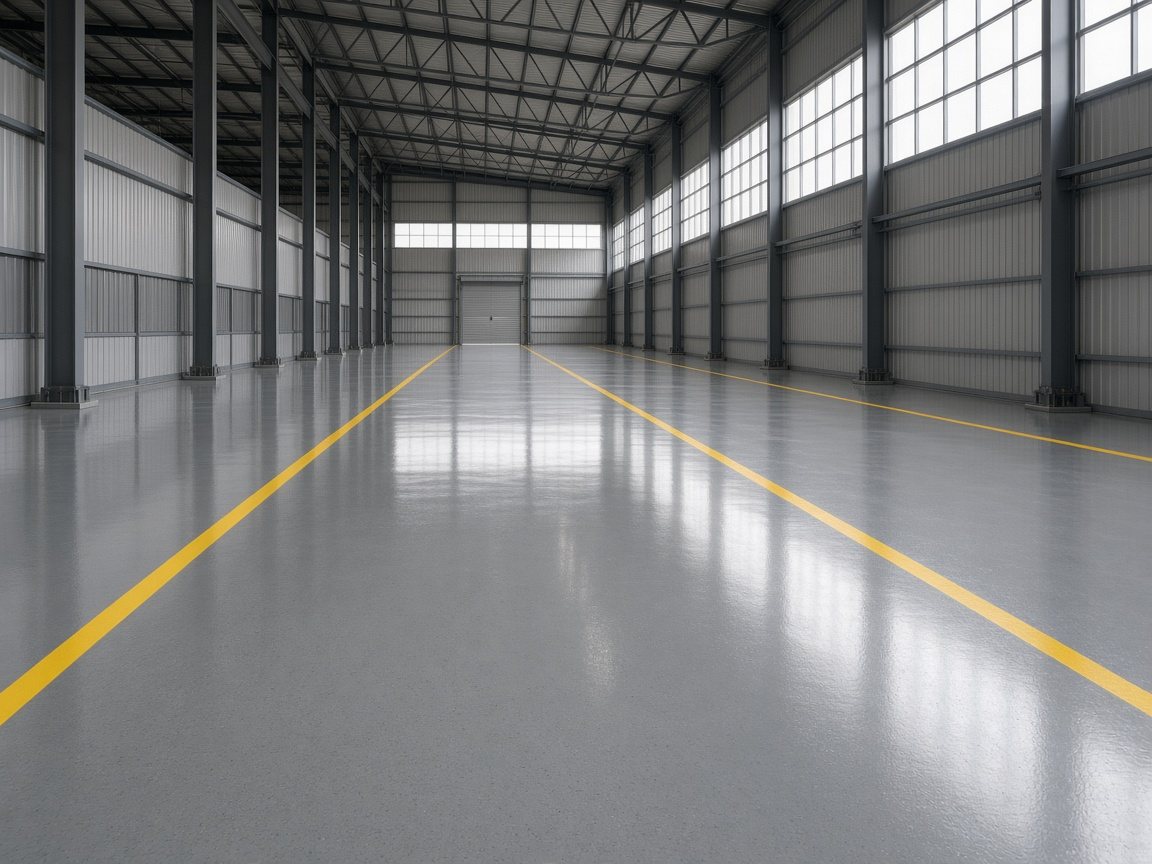
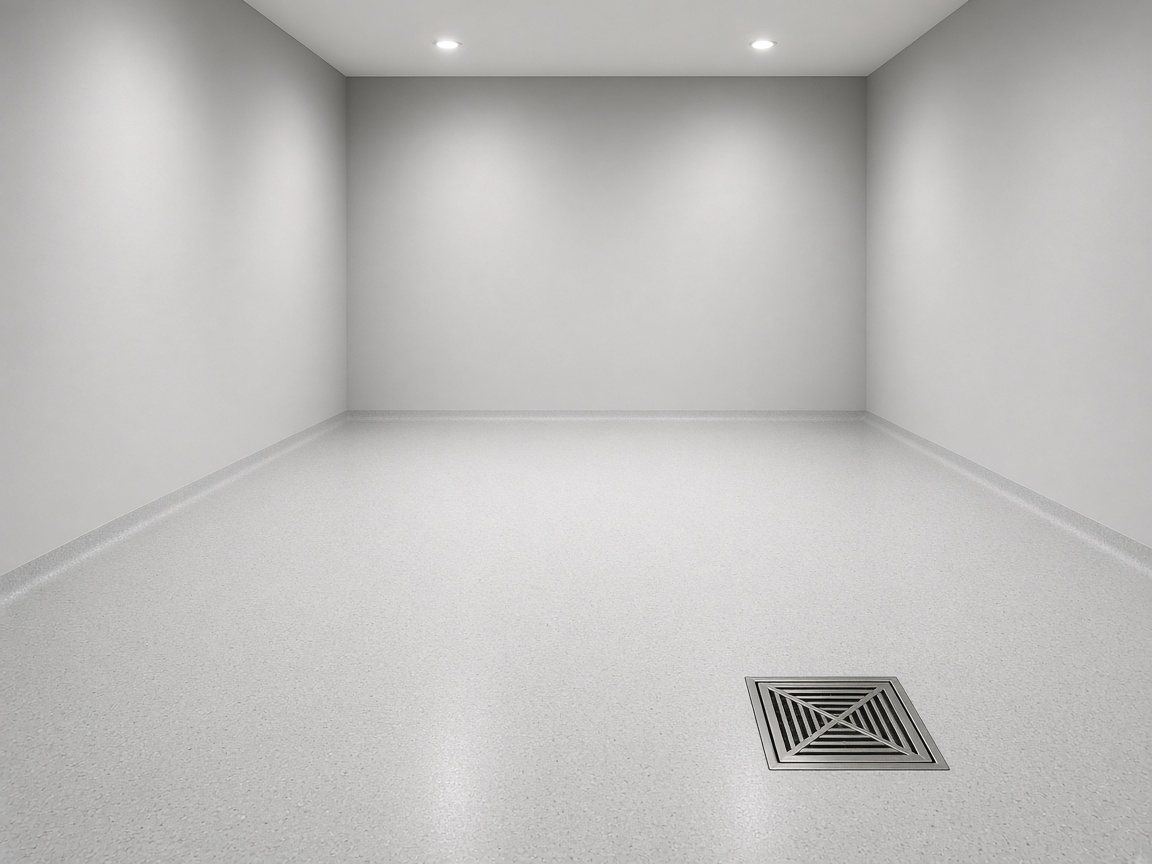
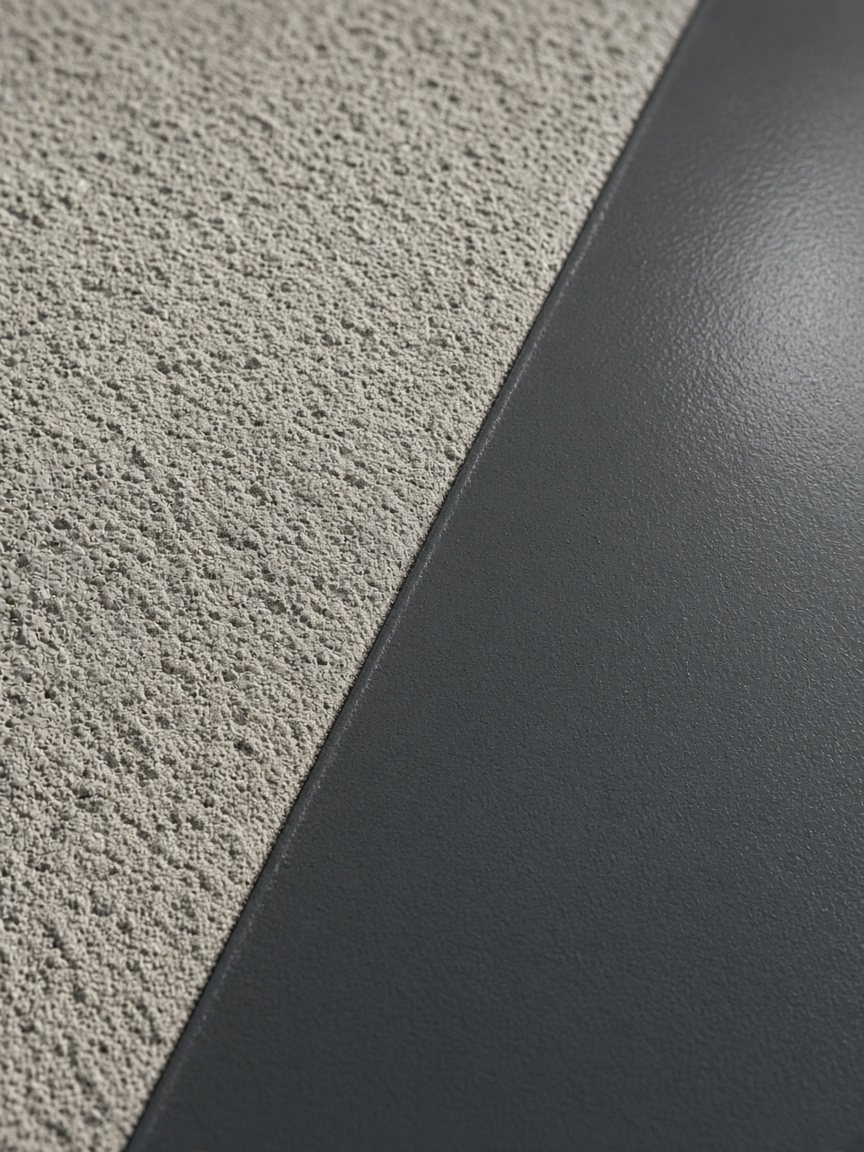
Choose your floor: commercial, industrial, prep or repair
- Commercial floors. Kitchens, back-of-house rooms, service bays, stock rooms and other floors that get mopped often and walked on all day. See commercial epoxy floor coating.
- Industrial floors. Plant floors, maintenance shops and process areas that carry forklifts, take chemical spills and need marked aisles. See industrial epoxy floor coating.
- Concrete preparation. Degreasing, surface profiling, and crack and joint repair, the work that happens before any resin is mixed. See concrete floor preparation for epoxy.
- Repair and recoating. Worn topcoats, chipped spots, failed joints and coatings that have started to peel. See epoxy floor repair and recoating.
Why a floor coating starts with the concrete
A resinous floor is not a single coat of paint. Manufacturers describe it as a poured, layered system applied on site over a substrate, usually concrete, where each layer has its own job: a primer to bond where the system needs one, a body coat for thickness and strength, a broadcast or grout coat for texture, and a topcoat that takes the chemicals, the cleaning and the wear (What Is Resinous Flooring).
Every one of those layers depends on the bottom one, and the bottom one depends on the concrete. That is why the federal guide specifications for resinous flooring all start in the same place: inspect the slab, confirm it is dry, and prepare the surface. One of them says plainly that "proper preparation of substrate is essential for satisfactory performance of resinous floor systems" (UFGS 09 67 23.14).
Another federal specification, written for a thin film system on industrial floors, names the three causes of early coating failure it wants an owner to head off: concrete with low surface strength, concrete with heavy surface contamination such as oils, fuels, fats and waxes, and concrete with a high rate of moisture vapor emission (UFGS 09 67 23.15). Each of those is a fact about the slab, not about the coating. Our page on concrete floor preparation walks through cleaning, profiling and repair, and our guide on why epoxy floors peel or bubble traces each failure back to its cause.
Moisture is checked before anything is coated
Concrete that looks dry is not always dry enough. The standard test method for measuring moisture vapor emission from a concrete floor starts from a plain statement: "All concrete subfloors emit some amount of moisture in vapor form" (ASTM F1869). Vapor emission simply means moisture leaving the slab as vapor. Under a coating that does not breathe, that vapor has nowhere to go.
The concrete industry treats this seriously. The American Concrete Institute's guide to slabs that receive moisture-sensitive flooring lists epoxy coatings among those materials, alongside vinyl, rubber, carpet and wood (ACI PRC-302.2-22).
A moisture test has limits too. The relative humidity method says its results show the slab's condition "only at the time of the test and in the specific locations tested" (ASTM F2170). Where the tests go and when they are read both matter. Our guide to concrete moisture testing before epoxy explains the calcium chloride test, the in-slab humidity test and the published reference limits.
Epoxy is one of several resin floors
"Epoxy floor" is the name most people use, but manufacturers sort resinous floors into several chemistries. They describe epoxy as resins, hardeners and fillers built for spills, machinery impact and heavy foot traffic, with strong adhesion to the substrate (Epoxy Flooring). They describe polyaspartic by its rapid cure and UV stability, and cementitious urethane by how it handles aggressive chemicals, temperature swings, constant moisture and thermal shock (Systems, Cementitious Urethane). Many floors use more than one: an epoxy base under a urethane topcoat is common in the federal specifications. A federal guide spec for chemical resistant floors says that "each job should be evaluated on its own merits" (UFGS 09 67 23.14). Our guide comparing epoxy, urethane and polyaspartic floor coatings sets them side by side.
Work planned around your business hours
A floor cannot be coated while forklifts are running across it or a kitchen line is cooking on it, so the schedule is part of the scope. Crew size is matched to the building and the schedule, and after-hours and holiday work is available to fit the business's hours, so a bay or a production area can be closed when it costs the least.
Before any preparation starts, floors, fixtures and equipment that stay in the room are protected. Equipment legs, floor drains and the edges of finished areas are the usual places that need it. Tools and materials are kept to the active area, so a floor done in sections leaves the rest of the building working, and the area is cleaned up at the end of each shift. Our guide to preparing a building for floor coating covers clearing the floor, heat, phasing and the return to use.
Who does the work
The floors are installed by our installation partner, a Kansas City crew with a record of commercial and industrial painting in the Kansas City area since 1978, and a BBB accredited business with an A+ rating. We take your photos and floor facts and put the scope in writing. Read more about us.
What a commercial floor coating costs
The price of a commercial floor coating moves most with the floor area, the condition of the slab, its moisture, the coating system and the hours the work has to fit. Our page on what an epoxy floor coating costs explains each of those and what a written quote should list.
Where we work in the Kansas City metro
We take on commercial and industrial floors across the Kansas City metro: Kansas City, Kansas, Kansas City, Missouri and the cities around them. See our service area.
Commercial floor coating questions
Can an epoxy coating go over an old, oily shop floor?
Often, yes, after the oil is dealt with. Contamination such as oils, fuels, fats and waxes is one of the three causes of early failure named in a federal thin film flooring specification, and a federal guide spec for chemical resistant floors matches the cleaning method to the contamination. The same guide says concrete that is badly cracked, crumbling or deeply contaminated with oil or fat should get a new concrete topping instead of a coating.
Does the concrete have to be tested for moisture first?
It should be. The ASTM relative humidity method notes that makers of floor systems generally require moisture testing before installation on concrete, and a federal guide spec for resinous flooring tells the installer to verify that the slab's vapor emission is within the manufacturer's written limit before any flooring goes down.
What should I send to get a quote?
Photos of the whole floor and of the worst areas, the approximate floor area, what the floor is used for, what is on it now and the hours work can happen. The quote page asks for each of these. More answers are on our FAQ page, and our floor coating guides go deeper.
Sources
- ASTM International, F2170, Standard Test Method for Determining Relative Humidity in Concrete Floor Slabs Using in situ Probes, read 2026-11-28
- ASTM International, F1869, Standard Test Method for Measuring Moisture Vapor Emission Rate of Concrete Subfloor Using Anhydrous Calcium Chloride, read 2026-11-28
- American Concrete Institute, PRC-302.2-22, Concrete Slabs that Receive Moisture-Sensitive Flooring Materials: Guide (public preview), read 2026-11-28
- Unified Facilities Guide Specifications, Section 09 67 23.13, Standard Resinous Flooring, November 2019, read 2026-11-28
- Unified Facilities Guide Specifications, Section 09 67 23.14, Chemical Resistant Resinous Flooring, August 2016 with Change 1 of August 2018, read 2026-11-28
- Unified Facilities Guide Specifications, Section 09 67 23.15, Fuel Resistive Resinous Flooring, 3-Coat System, February 2021, read 2026-11-28
- Sherwin-Williams High Performance Flooring, What Is Resinous Flooring, read 2026-11-28
- Sherwin-Williams High Performance Flooring, Systems, read 2026-11-28
- Sherwin-Williams High Performance Flooring, Epoxy Flooring, read 2026-11-28
- Sherwin-Williams High Performance Flooring, Cementitious Urethane, read 2026-11-28
Get a written quote for your floor
Send wide photos of the floor, close photos of the worst spots, and tell us what the floor is used for and when work can happen. Get a Quote