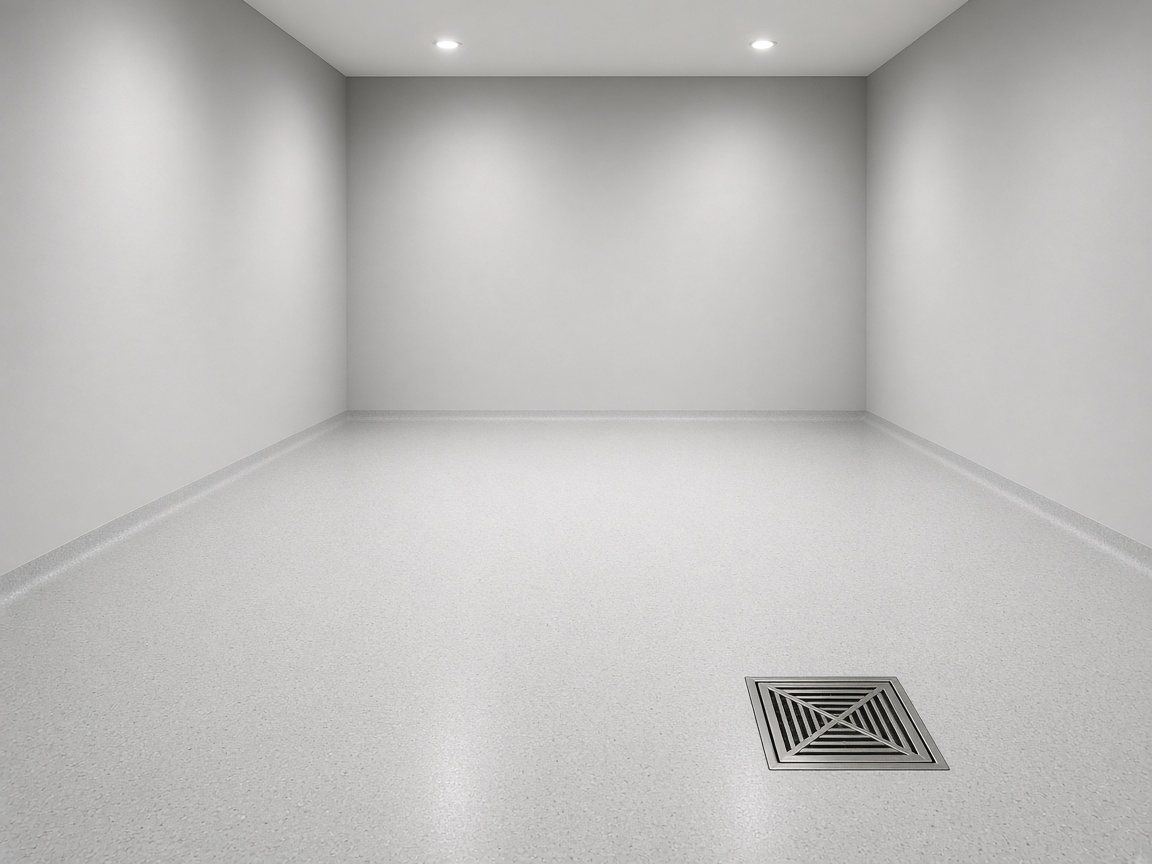
Commercial epoxy floor coating in Kansas City suits working floors that have to be cleaned often and take steady traffic, such as kitchens, back-of-house rooms, service bays and stock rooms, and the right system depends on what gets spilled, rolled and washed across it. A coated floor in a business is judged on three things: whether it stays bonded, whether it can be kept clean, and whether people can walk on it safely when it is wet.
Which commercial floors suit a resin coating
Resin floors earn their keep where bare concrete is hard to keep clean or wears fast. The usual commercial candidates are:
- Commercial kitchens and food prep rooms, where grease, water and cleaning chemicals hit the floor every day.
- Service and repair bays, with oil drips, rolling jacks and dropped tools.
- Stock rooms and back rooms, where carts and pallet jacks wear a path across bare concrete.
- Laundries, with standing water and detergent.
- Laboratories and clean-down areas, where spills have to be wiped up completely.
A federal guide specification for chemical resistant resinous flooring is written for exactly this kind of space: it is "primarily intended for use in biological laboratories, in similar areas which are subject to hard wear or spillage of chemicals and require a high degree of cleanliness" (UFGS 09 67 23.14). Heavier plant floors with forklifts and process chemicals are covered on our industrial epoxy floor coating page.
What a commercial resin floor is made of
Manufacturers describe a resinous floor as a layered system poured and built on site. Some systems use a primer to bond to the concrete, then a body coat for thickness and strength, then a broadcast or grout coat for texture and looks, and last a performance topcoat to stand up to chemicals, cleaning and wear (What Is Resinous Flooring).
The goal for a commercial room is a surface with no pores for dirt and bacteria to sit in. The federal guide specification for troweled epoxy flooring finishes its topping with two thin sealer coats to give "a pore-free, easy-to-clean surface" (UFGS 09 67 23.13). The same specification offers an integral cove base as an option, a curved joint where the floor material turns up the wall.
Matching the floor to what it has to resist
There is no one commercial floor. A federal guide spec for chemical resistant floors says the choice "should be based upon the ability of the system to withstand required exposure conditions", and that "each job should be evaluated on its own merits" (UFGS 09 67 23.14).
The same guide is plain about where an epoxy matrix is the wrong choice:
- where resistance to strong oxidizing acid solutions is required;
- where the floor sees prolonged temperatures above 130 degrees F;
- where it is frequently exposed to steam or boiling liquids;
- where the concrete underneath cannot be thoroughly dried.
That list matters in a kitchen. A dish room with hot water on the floor or a cook line near a kettle is a different exposure from a dry stock room, and it may call for a different resin. Our guide comparing epoxy, urethane and polyaspartic floor coatings explains how manufacturers describe each one.
Slip resistance and gloss in rooms that get wet
A smooth, glossy coating is easy to mop and can be slippery. The federal resinous flooring specification warns that "glossy final finishes may cause a slip hazard" when the floor is wet or oily, and tells the designer to specify the finish and the grit to suit the room (UFGS 09 67 23.13). Grit, sometimes called non-skid aggregate, is fine particles broadcast into or mixed with a coat to roughen the surface.
There is a trade-off. A federal thin film specification notes that considerably less grit may be appropriate on warehouse or architectural floors, and that added grit takes away from the floor's appearance (UFGS 09 67 23.15). The right texture in a kitchen aisle is not the right texture in a dry back room, and one floor can carry more than one texture.
Keeping the floor safe stays with the business. OSHA's general rule for walking and working surfaces says the floor of every workroom is kept clean and, as far as feasible, dry, with drainage where wet processes are used (29 CFR 1910.22). A coated floor can make that easier to do day to day. It does not do it on its own.
Floors in food businesses
Food rules are written about cleanability, and floors are named. The federal rule for food plants says a plant is built so that "floors, walls, and ceilings may be adequately cleaned and kept clean and kept in good repair" (21 CFR 117.20). The rule for meat and poultry establishments asks for walls, floors and ceilings "built of durable materials impervious to moisture" that are cleaned and sanitized as necessary (9 CFR 416.2).
A seamless resin floor with a cove base at the walls is one of the ways many food businesses answer that: no grout lines, no open corners, and a surface that sheds water. Whether a given floor meets the rule for a given business is decided by the operator and its inspector, not by a coating label. Ask the inspector early if the floor is part of a plan review.
What the slab needs before coating
The concrete gets the same attention in a café as in a factory. The federal resinous flooring specifications call for existing floors to be inspected, for the slab to be dry enough by the manufacturer's written limit, for paint, sealers, curing agents, oil and grease to be removed, and for cracks to be filled with a compatible material before the floor goes down (UFGS 09 67 23.13, UFGS 09 67 23.14). Kitchen floors that have soaked up years of grease are a particular case. See concrete floor preparation for epoxy and our guide to concrete moisture testing before epoxy.
Working around open hours
Most commercial floors belong to a business that cannot close for long. After-hours and holiday work is available to fit the business's hours, and crew size is matched to the building and the schedule, so the work can fall in the hours a kitchen is dark or over a holiday closing, and a large back room can be split into sections. Coolers, prep tables, shelving and drains that stay in place are protected before work starts, tools and materials stay in the area being coated, and the space is cleaned up at the end of each shift. Our guide to preparing a building for floor coating covers phasing and the return to use.
What a written commercial floor quote should list
A useful quote for a commercial floor names each of these, so two quotes can be compared line for line:
- the floor area, room by room;
- the preparation method and what it is meant to remove;
- the moisture test used, where it was run and the result;
- the system, layer by layer, with the thickness each layer is applied at from the product data sheet;
- the finish texture and grit for each room;
- joint, crack and cove base work;
- what the owner has to clear from the floor, and what the crew works around;
- when foot traffic, carts and cleaning can come back, taken from the product data sheet.
Commercial epoxy floor questions
Is epoxy the right floor for a commercial kitchen?
It depends on the heat and the washdown. A federal guide spec warns against an epoxy matrix where floors see steam, boiling liquids or sustained temperatures above 130 degrees F, and manufacturers point cementitious urethane at floors with temperature swings, constant moisture and thermal shock. A cool prep room and a dish room may need different answers.
Will a coated floor be slippery when wet?
It can be if it is left glossy. A federal resinous flooring specification warns that glossy finishes may be a slip hazard when wet or oily and has the designer specify the grit for the room. More grit means more grip and a floor that takes more effort to clean.
Can you coat over existing tile or sheet flooring?
Not as a rule. A federal guide spec says resinous floors should not go over existing resilient tile or sheet flooring. Where tile comes up first, another federal spec has the tile and mastic tested for asbestos before removal.
Can the work be done while we are closed?
Yes. After-hours and holiday work is available to fit the business's hours, and larger floors can be done in sections. How long each section stays closed comes from the product data sheet for the system chosen.
Sources
- Unified Facilities Guide Specifications, Section 09 67 23.13, Standard Resinous Flooring, November 2019, read 2026-11-28
- Unified Facilities Guide Specifications, Section 09 67 23.14, Chemical Resistant Resinous Flooring, August 2016 with Change 1 of August 2018, read 2026-11-28
- Unified Facilities Guide Specifications, Section 09 67 23.15, Fuel Resistive Resinous Flooring, 3-Coat System, February 2021, read 2026-11-28
- OSHA, 29 CFR 1910.22, Walking-Working Surfaces: General requirements, read 2026-11-28
- 21 CFR 117.20, Plant and grounds, as published by the Legal Information Institute, read 2026-11-28
- 9 CFR 416.2, Establishment grounds and facilities, as published by the Legal Information Institute, read 2026-11-28
- Sherwin-Williams High Performance Flooring, What Is Resinous Flooring, read 2026-11-28
- Sherwin-Williams High Performance Flooring, Systems, read 2026-11-28
- Sherwin-Williams High Performance Flooring, Cementitious Urethane, read 2026-11-28
Send photos of your floor for a quote
Send wide photos of each room, close photos of drains, joints and worn spots, and tell us what is spilled and washed on the floor and when it can be closed. We work across the Kansas City metro. To see what moves the price first, read what an epoxy floor coating costs. Get a Quote