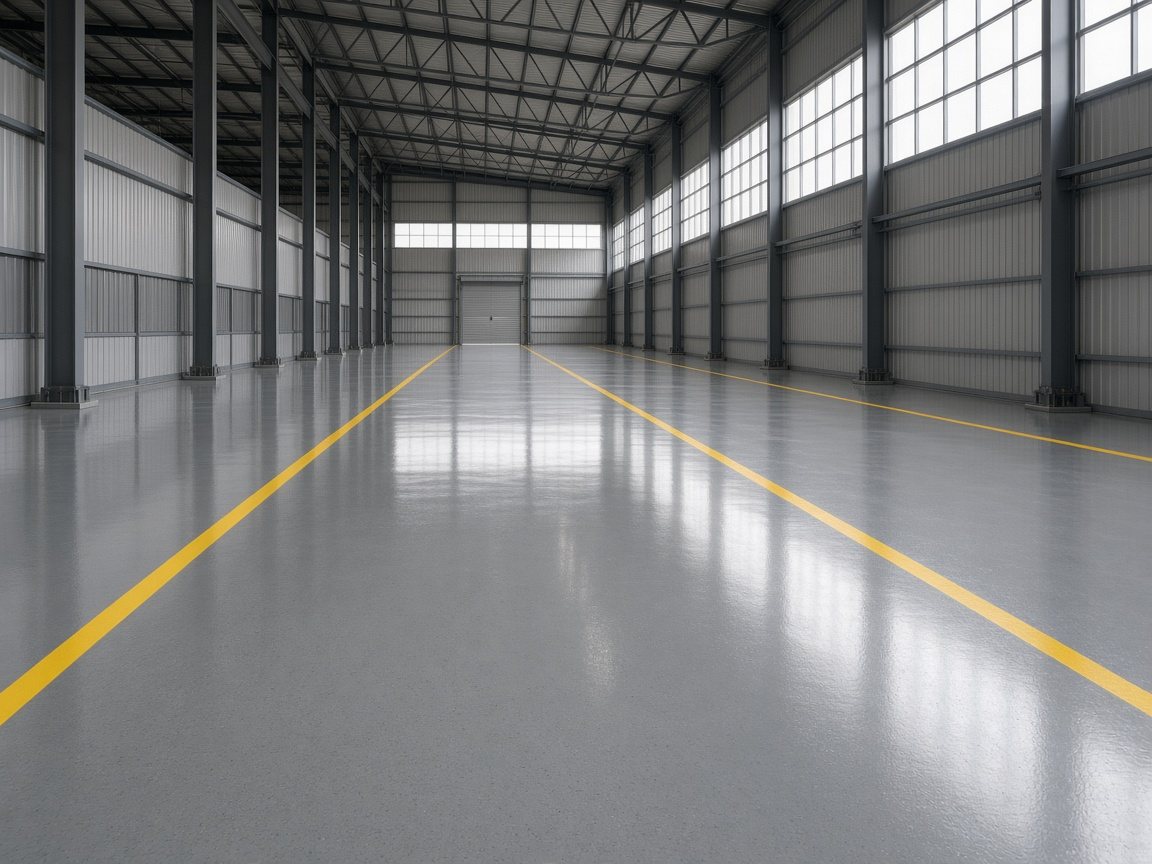
Industrial epoxy floor coating in Kansas City is built around three loads, wheels, chemicals and impact, so a plant or shop floor is specified from what drives over it and what spills on it, not from a color chart. Start with an honest list of the traffic and the chemicals, and the system, its thickness and its joint details follow from that list.
What an industrial floor has to stand up to
An industrial slab takes punishment a retail floor never sees:
- Wheel traffic and abrasion from forklifts, pallet jacks, carts and tow tractors, concentrated in the same aisles every shift.
- Chemical and fuel spills, from cutting fluids and hydraulic oil to cleaners and process chemicals.
- Impact from dropped parts, tools and pallets.
- Washdown, sometimes daily and sometimes hot.
- Thermal swings near ovens, docks and process lines.
The federal guide specifications for resinous flooring are written around these loads. One describes its thin film system as suited to "equipment maintenance shops, and all other industrial floors where resistance to abrasion and fuel is required" (UFGS 09 67 23.15). Another covers troweled floors for areas "subject to hard wear or spillage of chemicals" (UFGS 09 67 23.14). Lighter-duty kitchens, back rooms and service bays are covered on our commercial epoxy floor coating page.
Thin film coatings and troweled toppings
Industrial resin floors fall into two broad families, and the federal specifications show the difference in their own figures.
Thin film coatings are rolled or squeegeed on in coats measured in mils (thousandths of an inch). The federal fuel resistive specification describes a three-coat system, an epoxy primer and two urethane topcoats with non-skid grit, at a nominal 15 mils (UFGS 09 67 23.15).
Troweled toppings are epoxy binder mixed with graded aggregate and spread with a trowel, measured in fractions of an inch. The federal standard resinous flooring specification describes a topping at a nominal 3/16 inch (UFGS 09 67 23.13). The chemical resistant specification's note gives 1/8, 3/16 and 1/4 inch "for light, medium, and heavy duty traffic" (UFGS 09 67 23.14).
Those are the specifications' figures for their own systems, not a promise about any floor. The direction is what matters: heavier traffic and impact call for a thicker build. The product data sheet for the system chosen sets the actual thickness of each layer, and the quote should name it.
Chemical resistance is checked chemical by chemical
"Chemical resistant" on a brochure means little until it is matched to the chemicals in your plant. The federal chemical resistant flooring specification tests its floors against a named list of reagents and tells the designer that "manufacturer's literature should be checked" for any specific chemical the facility uses (UFGS 09 67 23.14).
The same specification lists where an epoxy matrix should not be used: strong oxidizing acid solutions, prolonged temperatures above 130 degrees F, frequent steam or boiling liquids, and a slab that cannot be thoroughly dried. If any of those describe part of your floor, that area may need a different resin. Our guide comparing epoxy, urethane and polyaspartic floor coatings describes the alternatives.
The practical step: write down every chemical that reaches the floor, with its strength and temperature, and ask for the manufacturer's resistance chart against that list.
Joints, cracks and forklift traffic
Forklift wheels find every edge in a floor, and the federal thin film specification spends real effort on joints and cracks (UFGS 09 67 23.15):
- Hairline cracks up to 1/8 inch wide are typically not repaired; wider cracks can be chased (cut open) and sealed.
- Joints are cleaned out, fitted with backer rod and sealed, and the sealant cures before coating.
- On warehouse floors "with heavy forklift traffic, a semi-flexible joint sealant is required" in place of the specified flexible one.
- Slab ends that have curled or settled at joints are leveled by scarifying before coating.
Ask that the quote say how each joint type will be treated. A coating that bridges a moving joint will crack along it.
Aisle and walkway marking
Marked aisles are not decoration in a plant. OSHA's rule on handling materials says that where mechanical handling equipment is used, aisles and passageways are kept clear and in good repair, and "permanent aisles and passageways shall be appropriately marked" (29 CFR 1910.176). The rule does not set the method or the color.
On a coated floor, stripes can be built into the system. The federal thin film specification applies walkway stripes in a contrasting topcoat color with grit (UFGS 09 67 23.15). Have your safety team mark the layout before the work is scoped, so the stripes are part of the quote rather than an afterthought.
Dust control when concrete is prepared indoors
Preparing a plant floor means grinding or blasting concrete inside an occupied building. Concrete contains crystalline silica, and grinding it makes very small dust particles that can travel deep into the lungs and cause silicosis, which OSHA calls "an incurable and sometimes deadly lung disease" (OSHA Fact Sheet).
OSHA's construction silica standard lists "walk-behind milling machines and floor grinders" as their own task with listed controls: a machine with water fed to the cutting surface, or a dust collection system recommended by the machine's maker with a filter of 99% or greater efficiency. Indoors, loose dust is removed with a HEPA-filtered vacuum between passes. Dry sweeping and cleaning with compressed air are restricted where they could add to exposure (29 CFR 1926.1153).
Ask any contractor which control they will use on your floor and how the work area will be separated from running production.
Topcoats that can be renewed
An industrial floor wears from the top down. The federal thin film specification notes its system "can be rejuvenated by replacing urethane topcoats, and non-skid, only" (UFGS 09 67 23.15). In other words, a well-bonded floor with a worn wearing surface may not need to be stripped and rebuilt. Whether a given floor can take a new topcoat is covered on our epoxy floor repair and recoating page.
Testing and inspection on a critical floor
On a floor that has to perform, ask for evidence at three points:
- Before coating: moisture. The federal guide specifications have the slab's moisture checked before coating: one against the manufacturer's written limit (UFGS 09 67 23.13), and the thin film specification against its own vapor emission limit (UFGS 09 67 23.15). See our guide to concrete moisture testing before epoxy.
- During application: conditions. The thin film specification records air temperature, floor temperature and relative humidity at the start and every hour, and inspects each coat for improperly cured material, blisters, wrong thickness and other defects.
- After curing: adhesion. A pull-off test glues a small fixture to the coating and pulls it straight up until something breaks; the broken face shows which layer was weakest (ASTM D7234). The thin film specification runs a pull-off test (to ASTM D4541) on its newly installed floor at a minimum of three spots and accepts the result when the break is in the concrete itself. The test is destructive, so spot repairs may be needed afterward.
How the slab is readied before any of this is on our concrete floor preparation page.
Industrial floor coating questions
How thick is an industrial epoxy floor?
It depends on the system. One federal specification describes a thin film system at a nominal 15 mils, another a troweled epoxy topping at a nominal 3/16 inch, and a third gives 1/8, 3/16 and 1/4 inch for light, medium and heavy traffic. The product data sheet for the chosen system sets the real figure.
Will epoxy hold up to forklifts?
A properly specified system is made for it. In the federal guidance, thickness goes up with traffic class, and warehouse floors with heavy forklift traffic call for a semi-flexible joint sealant. How long any floor lasts depends on its traffic, cleaning and upkeep.
Does a floor coating meet OSHA rules?
No coating does that on its own. OSHA's rules put the duty on the employer to keep floors clean, dry where feasible and free of hazards, and to mark permanent aisles where handling equipment runs. A coated, striped floor can make those duties easier to keep.
Can part of the plant keep running during the work?
Usually the floor is done in sections. Tools and materials are kept to the active area, crew size is matched to the building and the production schedule, and after-hours and holiday work is available. Shutdown weeks are often the easiest time for the areas that cannot be closed otherwise.
Sources
- ASTM International, D7234, Standard Test Method for Pull-Off Strength of Coatings on Concrete Using Portable Pull-Off Adhesion Testers, read 2026-11-28
- Unified Facilities Guide Specifications, Section 09 67 23.13, Standard Resinous Flooring, November 2019, read 2026-11-28
- Unified Facilities Guide Specifications, Section 09 67 23.14, Chemical Resistant Resinous Flooring, August 2016 with Change 1 of August 2018, read 2026-11-28
- Unified Facilities Guide Specifications, Section 09 67 23.15, Fuel Resistive Resinous Flooring, 3-Coat System, February 2021, read 2026-11-28
- OSHA, 29 CFR 1926.1153, Respirable Crystalline Silica, read 2026-11-28
- OSHA Fact Sheet, OSHA's Respirable Crystalline Silica Standard for Construction, read 2026-11-28
- OSHA, 29 CFR 1910.22, Walking-Working Surfaces: General requirements, read 2026-11-28
- OSHA, 29 CFR 1910.176, Handling materials: general, read 2026-11-28
Describe your plant floor for a quote
Send wide photos of the floor, close photos of joints, cracks and worn aisles, the list of chemicals that reach the floor, and the shifts or shutdown dates when areas can close. We work across the Kansas City metro. To see what moves the price, read what an epoxy floor coating costs. Get a Quote