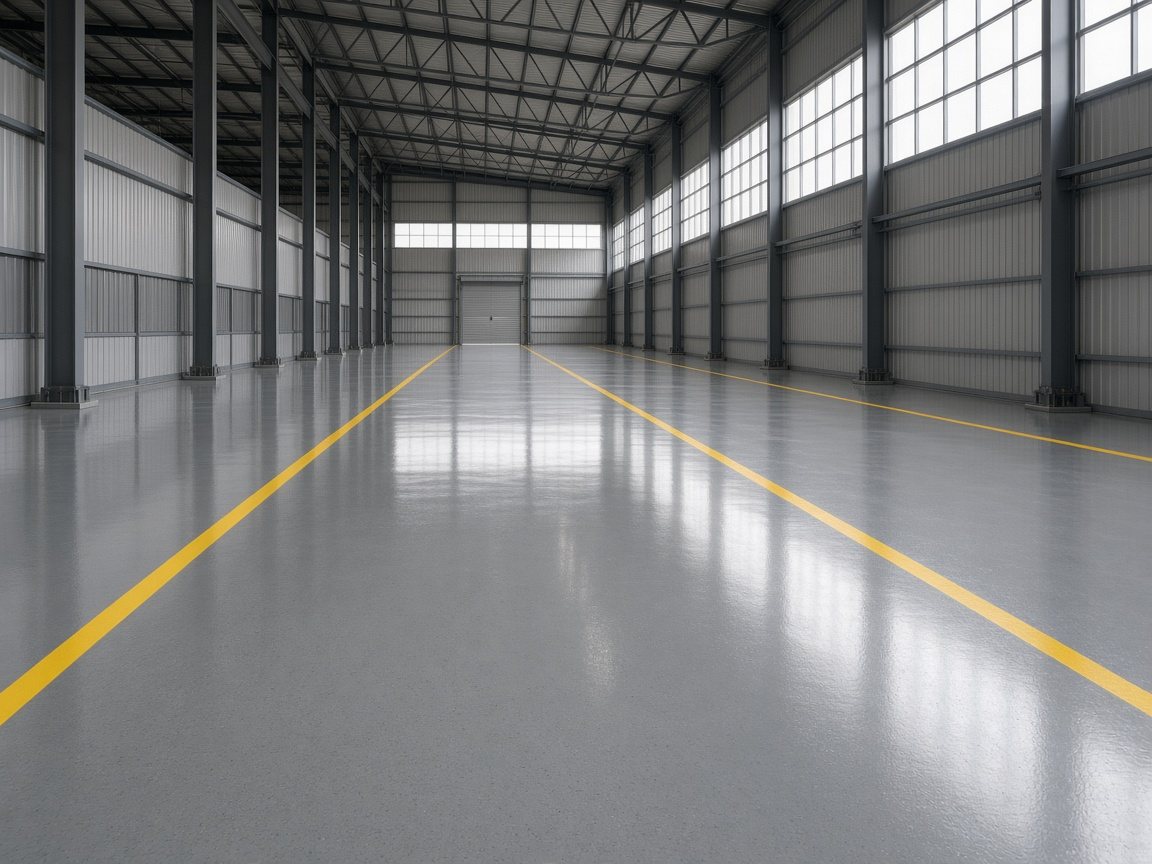
An epoxy floor coating in Kansas City is priced floor by floor from photos and slab facts, and five things move a commercial quote most: the floor area, the condition of the concrete, its moisture, the coating system and the hours the work has to fit. This page explains each one, so you can see why two floors of the same size can be quoted very differently. It also shows the published national ranges that exist for epoxy floors, and why they are a starting point for a commercial floor, not a price for one.
Published national range for epoxy floors
The closest public figures come from Angi's national cost guide for epoxy flooring. That guide is written mostly for garage and home concrete floors, so treat these as a general consumer benchmark. They are not commercial or industrial prices, they are not Kansas City prices, and they are not this business's prices.
| Item in the national guide | Published national range |
|---|---|
| Professional epoxy flooring, installed, materials and labor | Estimate: $2 to $12 per square foot |
| Labor alone | Estimate: $1 to $7 per square foot |
| Water-based epoxy resin | Estimate: $30 to $50 per gallon |
| Solvent-based epoxy resin | Estimate: $40 to $55 per gallon |
| Solid epoxy resin | Estimate: $45 to $150 per gallon |
| Concrete patching before coating | Estimate: $25 to $250 |
| Concrete resurfacing before coating | Estimate: $1,000 to $5,000 |
Source: Angi, How Much Does Epoxy Flooring Cost? [2026 Data], page updated Oct 30, 2026, read 2026-11-28.
The same guide names floor size, resin type and surface preparation as the things that drive the price, says epoxy needs surface preparation before it goes down, and says cracked or damaged concrete is repaired first. It also notes that a basic clear coating costs less than a decorative one. Those points hold for commercial floors too, but a working floor adds items a home garage rarely has: moisture testing and mitigation, thicker troweled systems, chemical resistance, cove base, striping and after-hours schedules. The sections below explain each one, and they are why a commercial floor can land anywhere against the national range, or outside it.
What moves the price of a commercial floor coating
- Floor area and layout: how big the floor is, and how much of it is edges, corners and obstacles.
- Slab condition and preparation: oil, old coatings, cracks, joints and weak concrete.
- Moisture test results: whether the slab is dry enough for the coating, or needs time or a mitigation layer first.
- The coating system and its thickness: a thin film coating or a troweled topping, and the extras such as grit, cove base and stripes.
- Schedule, access and working hours: nights, holidays, phasing around a live operation, and moving equipment.
Testing and inspection an owner asks for add a sixth, smaller line.
Floor area and layout
Area sets the scale of the job, but layout decides how efficiently it goes. A large open floor lets the big preparation machines run long, straight passes. A small room full of drains, equipment legs, columns and wall edges does not. The federal thin film flooring specification prepares the open floor by shot blasting and handles edges and spots the blaster cannot reach separately, by diamond grinding or light scarifying (UFGS 09 67 23.15). That edge and detail work is slower per square foot than the open field, so a cramped kitchen can cost more per square foot than a wide shop floor.
Slab condition and preparation
Preparation is often the largest variable in a floor quote. Items that add to it:
- Oil and grease. Degreasing comes before any blasting, with rinsing until the water runs clear, and stubborn spots get repeat treatment (UFGS 09 67 23.15).
- An old coating. The same specification warns that "in general, a coating system cannot be completely removed by shot blasting" alone, so removal can take several methods.
- Cracks, joints and spalls. Each is filled or sealed with a compatible material before coating, and joints on warehouse floors with heavy forklift traffic get a semi-flexible sealant (UFGS 09 67 23.14, UFGS 09 67 23.15).
- Ruined concrete. At the far end, a federal guide spec says concrete that is badly cracked, crumbling or deeply soaked with oil or fat should get a new concrete topping instead of a coating, which is a different scale of job.
In the national guide, concrete patching before coating runs Estimate: $25 to $250 and resurfacing runs Estimate: $1,000 to $5,000, both general figures from home projects. A commercial slab with long joint runs, spalls or an old coating to remove is scoped on its own, so those ranges show only that repair is a separate line, not what it costs on a working floor.
Our page on concrete floor preparation for epoxy explains each step.
Moisture test results
A slab that tests over the coating manufacturer's limit has a few paths, and each costs something: wait for it to dry, with heat and dehumidifiers where possible, or put down a moisture mitigation system the manufacturer approves before the coating, or switch to a breathable coating or a less moisture-sensitive floor (NRMCA CIP 28). Membrane-forming moisture mitigation is a recognized category with its own ASTM practice, written for resilient flooring rather than coatings (ASTM F3010), and the federal thin film specification requires a moisture reducing system over shot blasted concrete when its test result is too high.
The ready mixed concrete association advises including moisture mitigation in a bid "at least as a contingency item", and the result is not known until the slab is tested. Our guide to concrete moisture testing before epoxy explains the tests.
The coating system and its thickness
The system is the part most people picture when they think about price. The main choices:
- Thin film or troweled. A thin film coating is measured in mils; a troweled epoxy topping is measured in fractions of an inch and carries much more material (UFGS 09 67 23.13, UFGS 09 67 23.15).
- Traffic class. A federal guide spec scales troweled floor thickness from light to medium to heavy duty traffic (UFGS 09 67 23.14).
- Chemical resistance. Floors that see strong chemicals or hot washdown may need a different resin from plain epoxy.
- Grit and finish. Non-skid grit in wet rooms and traffic lanes.
- Cove base. A curved joint where the floor turns up the wall, common in kitchens and food rooms.
- Aisle striping. Walkways and aisles in a contrasting topcoat color.
Material is only part of the system's cost. The national guide puts epoxy resin at Estimate: $30 to $50 per gallon for water-based, Estimate: $40 to $55 for solvent-based and Estimate: $45 to $150 for solid epoxy, all general figures, not this business's prices. A thicker build uses more material per square foot, and a specialty resin for chemicals or heat is a different product again.
Our guide comparing epoxy, urethane and polyaspartic floor coatings explains what each resin is for.
Schedule, access and working hours
A floor done on a weekday with the room empty is the simplest case. Night, weekend and holiday work, phasing a floor in sections around a live operation, and working around equipment that cannot move all add hours. Crew size is matched to the building and the schedule, and after-hours and holiday work is available to fit the business's hours. The more of the floor that can be cleared and closed at once, the fewer separate setups the job needs.
Testing and inspection an owner asks for
Each of these adds some cost and takes some risk out of the job:
- Pull-off adhesion tests, which pull a small fixture off the coating to show the weakest layer. The test is destructive, so spot repairs may be needed afterward (ASTM D7234).
- More moisture test locations. The ready mixed concrete association's guidance is three locations for the first 1,000 square feet and one more for each additional 1,000.
- A mockup area. A federal flooring specification builds a sample area first to set the standard for appearance and workmanship (UFGS 09 67 23.13).
What a written floor coating quote should list
A quote you can compare against another one should name:
- the area, room by room or zone by zone;
- the preparation method and the target surface profile;
- the moisture test type, locations and results, or how mitigation is handled if they are not in yet;
- each coat in the system and its thickness, taken from the product data sheet;
- the joint, crack and spall scope;
- what is excluded;
- what the owner clears from the floor before work;
- when foot traffic, wheeled traffic and cleaning can return, from the product data sheet.
For the kinds of floors we quote, see commercial and industrial floor coating, or repair and recoating for an existing floor.
Floor coating cost questions
Is there a price per square foot for a commercial epoxy floor?
Not one we can honestly publish. The national guide's installed range, Estimate: $2 to $12 per square foot, is a general figure written mostly about home and garage floors. Commercial floors differ too much in preparation, moisture and system for that range to stand in for a quote. A clean, dry, open slab and an oil-soaked kitchen with an old coating are different jobs, so each floor is priced from its own photos and facts.
What usually adds the most to a floor coating quote?
Preparation and moisture. Removing an old coating or deep contamination can take several methods, and a moisture mitigation layer under the coating is a separate system with its own cost.
Is a thin coating cheaper than a troweled floor?
Generally it uses less material and labor, but it suits lighter duty. A federal guide spec scales troweled floor thickness with traffic, so a floor that carries heavy wheels and impact may need the thicker build either way.
Should moisture mitigation be in the quote?
It should at least be listed as a contingency. The ready mixed concrete association advises including moisture mitigation in a bid at least as a contingency item, and the slab's result may not be known when the price is set.
Sources
- Angi, How Much Does Epoxy Flooring Cost? [2026 Data], page updated Oct 30, 2026, read 2026-11-28. National consumer cost guide, written mostly for home and garage floors.
- ASTM International, D7234, Standard Test Method for Pull-Off Strength of Coatings on Concrete Using Portable Pull-Off Adhesion Testers, read 2026-11-28
- ASTM International, F3010, Standard Practice for Two-Component Resin Based Membrane-Forming Moisture Mitigation Systems for Use Under Resilient Floor Coverings, read 2026-11-28
- National Ready Mixed Concrete Association, CIP 28, Concrete Slab Moisture, 2017, read 2026-11-28
- Unified Facilities Guide Specifications, Section 09 67 23.13, Standard Resinous Flooring, November 2019, read 2026-11-28
- Unified Facilities Guide Specifications, Section 09 67 23.14, Chemical Resistant Resinous Flooring, August 2016 with Change 1 of August 2018, read 2026-11-28
- Unified Facilities Guide Specifications, Section 09 67 23.15, Fuel Resistive Resinous Flooring, 3-Coat System, February 2021, read 2026-11-28
Get a written price for your floor
Send photos of the floor and the worst areas, the approximate area, what the floor is used for and when work can happen, and we will scope it in writing. Back to the home page. Get a Quote